
Audits Delivered
Standards Referenced
Testing Instruments
100%
Compliance Focused
Our Methodology
A six-phase audit process built on field discipline.
Every audit follows a structured workflow — from opening meeting to final report — so nothing in your installation is left unchecked
01
Opening Meeting & Scoping
Kick-off with the facility engineer, walk-through of the Single Line Diagram (SLD), and finalisation of audit scope, schedule and safety protocols.
02
Document & Compliance Review
Verification of statutory approvals — CEIG, DG set, lift, lightning protection — plus maintenance logs, test records and operator competency.
03
Field Inspection
Visual inspection of transformers, HT/LT panels, DG sets, capacitor banks, UPS, cable trays, earthing system and electrical rooms.
04
Instrumented Testing
On-site testing using calibrated instruments — BDV, IR, earth resistance, thermography, power quality and relay testing.
05
Risk Analysis & Gap Assessment
Findings are mapped against IS 5216, IS 3043, NEC, NFPA 70/70E/70B and CEA 2010 regulations and ranked by severity.
06
Reporting & Closure Meeting
A detailed report with photographs, thermograms, observations and corrective recommendations is presented to management.
Instrumented Testing
Specialised equipment for every critical test.
We use calibrated, industry-standard instruments — each test follows a documented procedure with quantified pass/fail criteria.
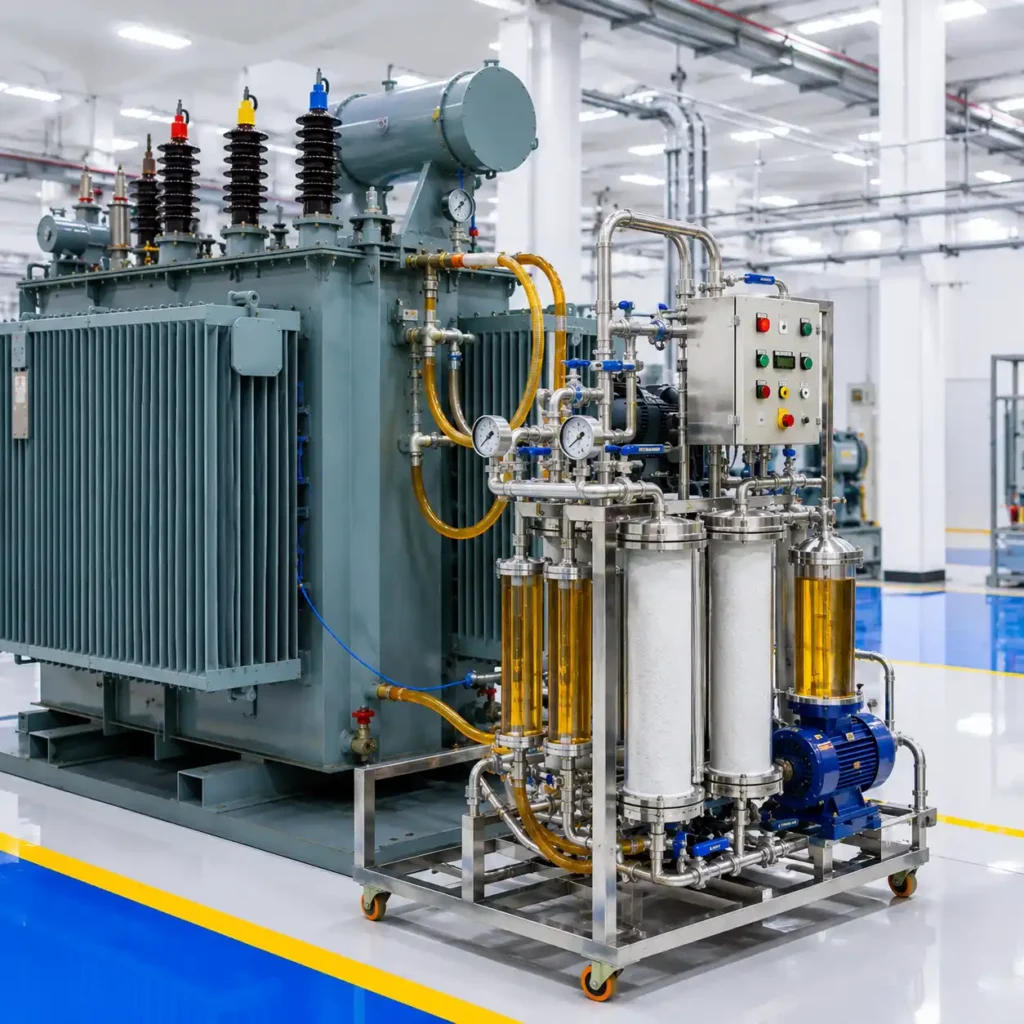
Transformer Oil Filtration
Vacuum dehydration & purification of insulating oil
Why it matters: Moisture, sludge and dissolved gases reduce the dielectric strength of transformer oil and accelerate insulation ageing, leading to failures and fire risk.
Test Procedure
- Isolate transformer and drain a sample of oil for pre-test analysis.
- Connect high-vacuum filtration plant through inlet/outlet valves.
- Heat oil to 60–65°C and circulate through vacuum chamber to remove moisture, gases and particulates.
- Continue filtration until BDV ≥ 60 kV and moisture ≤ 10 ppm is achieved.
- Re-test the oil and document final dielectric values.

BDV (Breakdown Voltage) Testing
Dielectric strength of transformer / switchgear oil
Why it matters: BDV indicates the oil’s ability to withstand electrical stress. Low BDV means contaminated oil that can flash-over inside a live transformer.
Test Procedure
- Collect oil sample in a clean, dry BDV test cup.
- Place sample in tester with 2.5 mm gap between standard electrodes.
- Apply rising AC voltage at 2 kV/s until breakdown occurs.
- Repeat 6 cycles with 1-minute stirring intervals.
- Report the average breakdown voltage in kV.
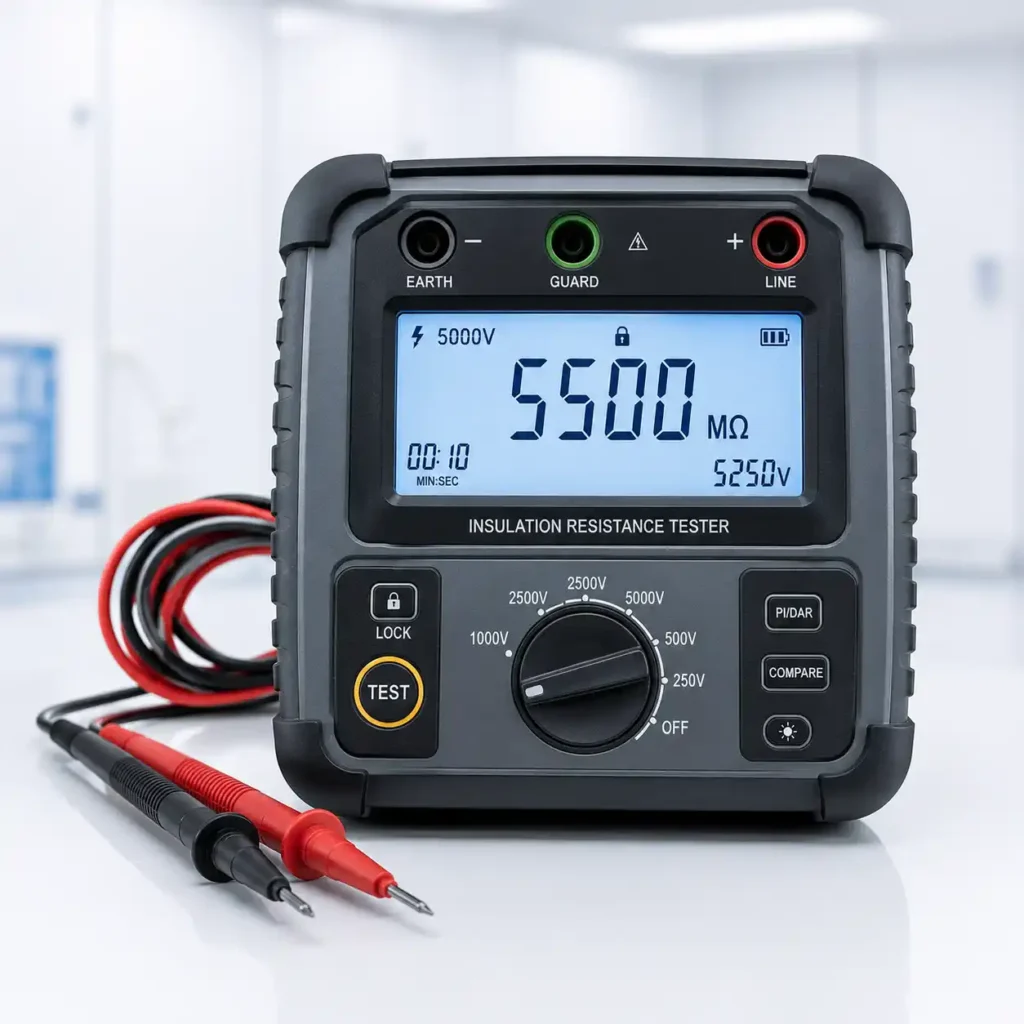
Insulation Resistance (IR) Testing
Megger testing of cables, motors & panels
Why it matters: Degraded insulation causes leakage currents, earth faults and shock hazards. IR testing detects insulation weakness before it becomes a failure.
Test Procedure
- De-energise the circuit and discharge any stored capacitance.
- Connect megger leads between conductor and earth (and phase-to-phase).
- Apply 500 V / 1000 V / 2500 V DC depending on system voltage.
- Maintain test voltage for 60 seconds and record IR value in MΩ / GΩ.
- Calculate Polarisation Index (PI = 10 min / 1 min) — should be > 2.0.
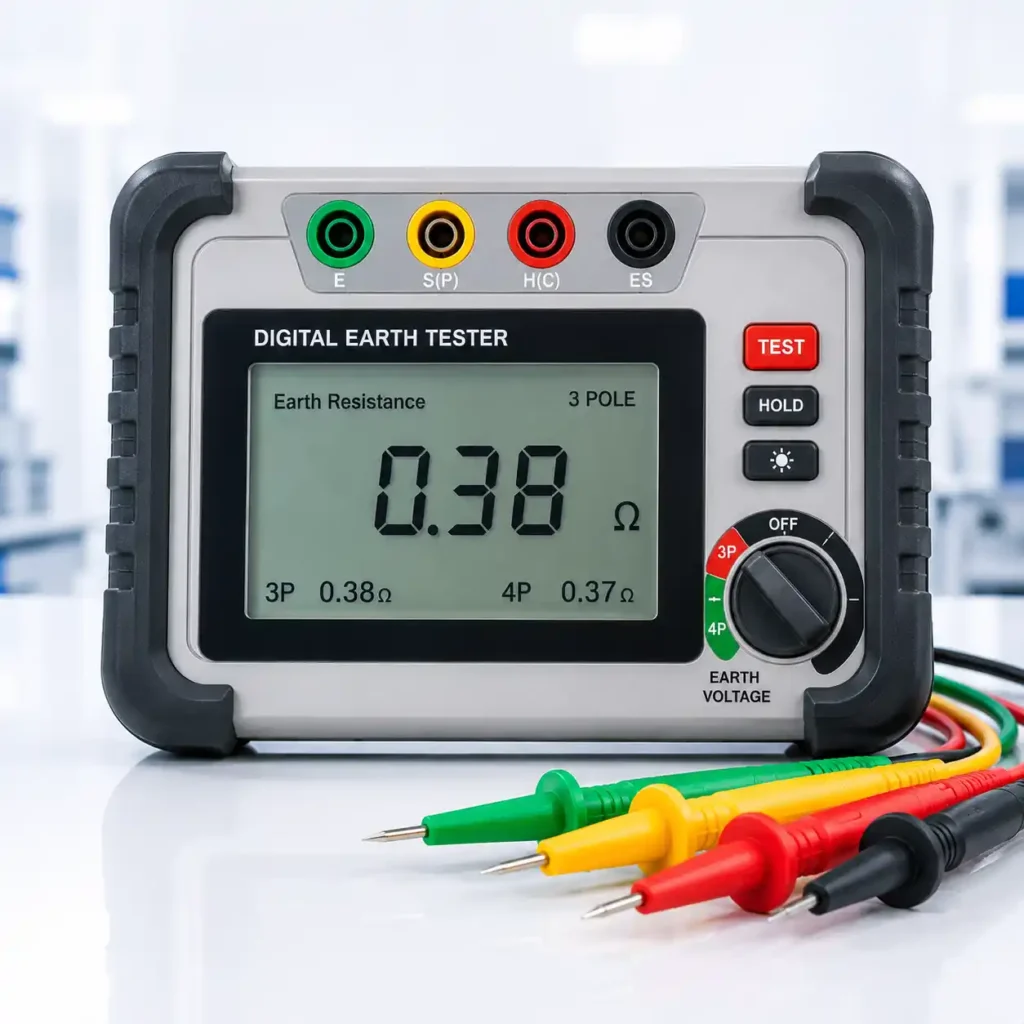
Earth Pit Resistance Testing
Verification of earthing system effectiveness
Why it matters: A high earth resistance defeats the entire protection scheme — fault currents won’t trip breakers and exposed metal parts can become live.
Test Procedure
- Disconnect earth conductor from the pit being tested.
- Drive auxiliary spikes at 15 m and 25 m in a straight line (fall-of-potential method).
- Connect 3-terminal / 4-terminal earth tester and inject test current.
- Read earth resistance — target ≤ 1 Ω for body, ≤ 2 Ω for neutral, ≤ 5 Ω for lightning.
- Top-up pit with salt/charcoal/water if value is high; re-test.
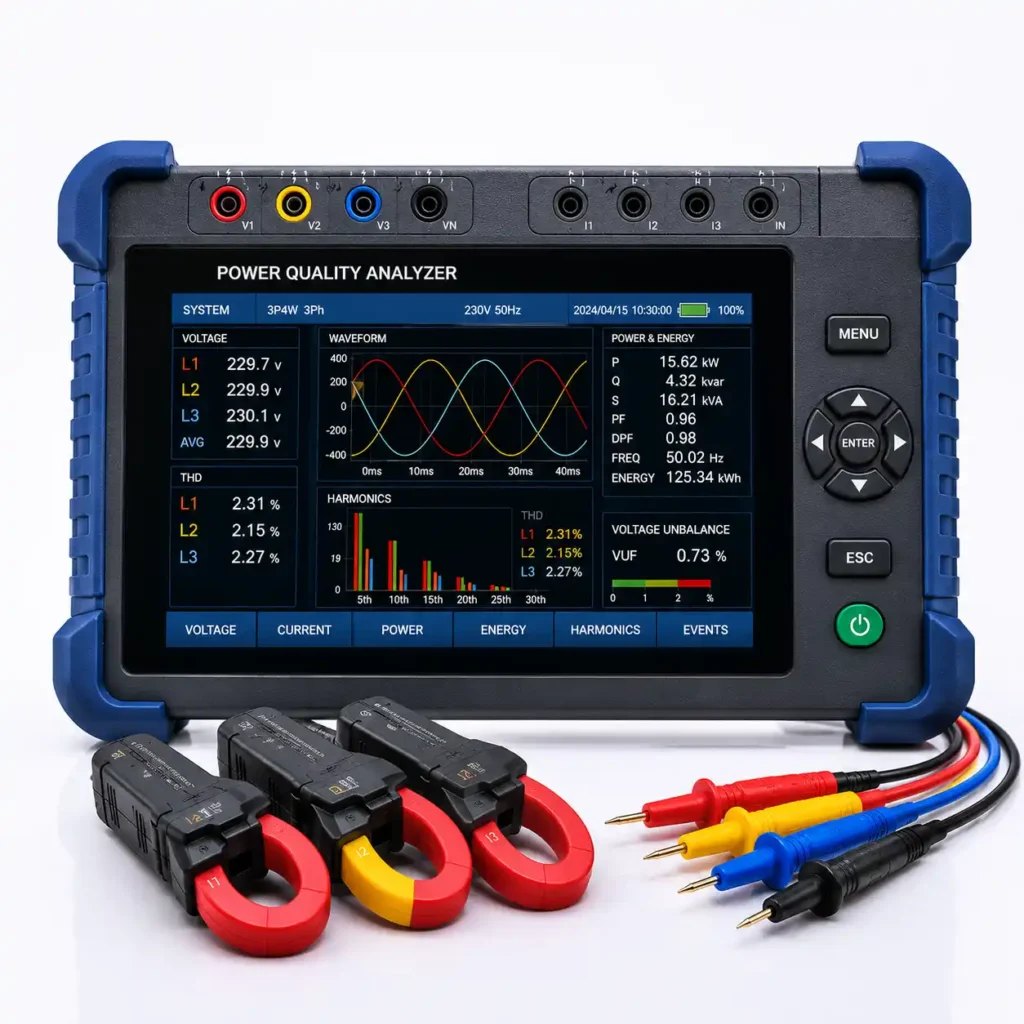
Power Quality Analysis
Voltage, current, harmonics, PF & load study
Why it matters: Harmonics, unbalance and poor power factor overheat cables, trip equipment and inflate energy bills. A power study quantifies the actual electrical health.
Test Procedure
- Clamp CTs on each incoming phase and connect voltage probes.
- Log voltage, current, kW, kVAR, kVA, PF, THD-V and THD-I for 24–168 hours.
- Analyse waveform distortion, sag/swell events and unbalance %.
- Compare against IEEE 519 limits (THD-V ≤ 5%, THD-I ≤ 8%).
- Recommend harmonic filters, APFC tuning or load redistribution.
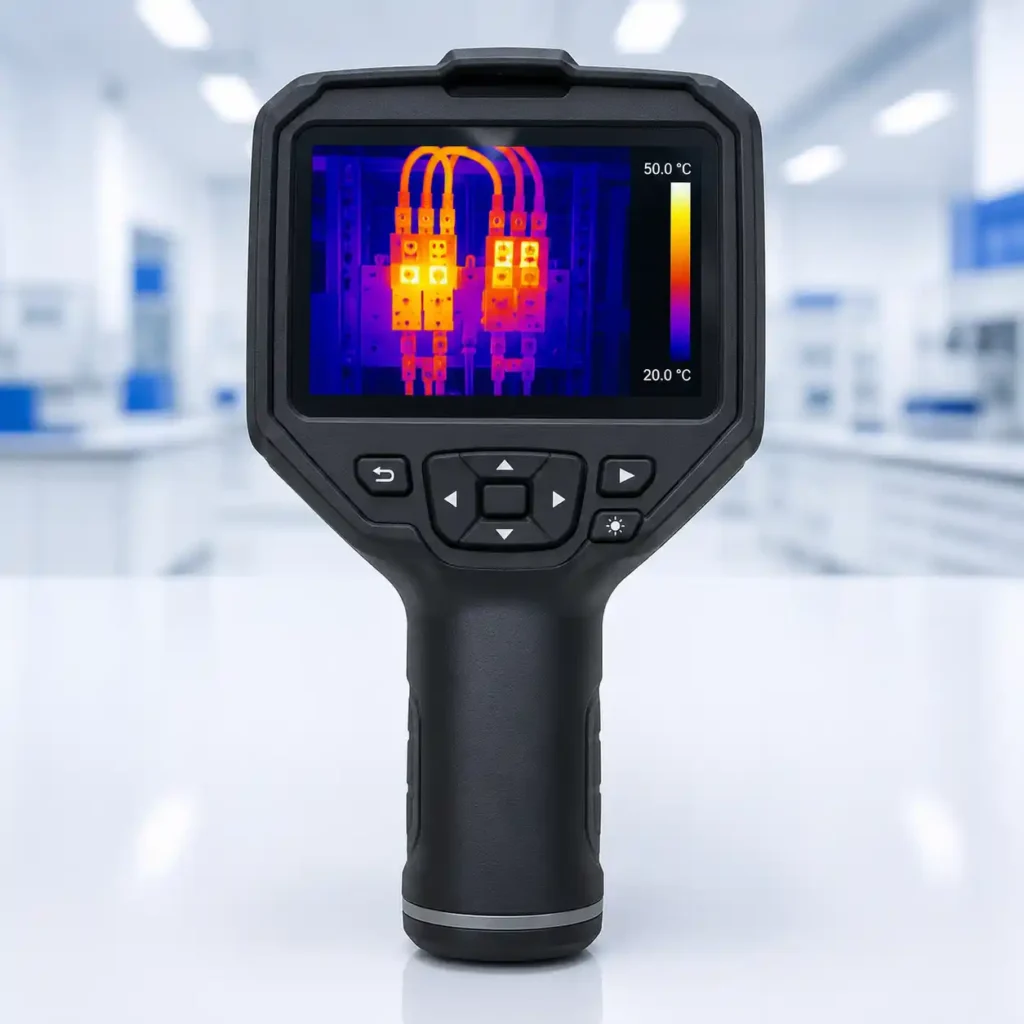
Thermography (IR Scanning)
Non-contact hot-spot detection in live panels
Why it matters: Loose joints, overloaded cables and failing components generate heat long before they fail. A thermal scan finds these silent faults without shutdown.
Test Procedure
- Ensure the system is energised and loaded to at least 40% of full load.
- Open panel doors safely with appropriate PPE & arc-flash rating.
- Scan every joint, bus-bar, breaker and cable termination with IR camera.
- Flag any ΔT > 10°C (Class 2) or > 30°C (Class 4 — critical) against reference.
- Issue prioritised report with thermograms, RGB photos and corrective actions.
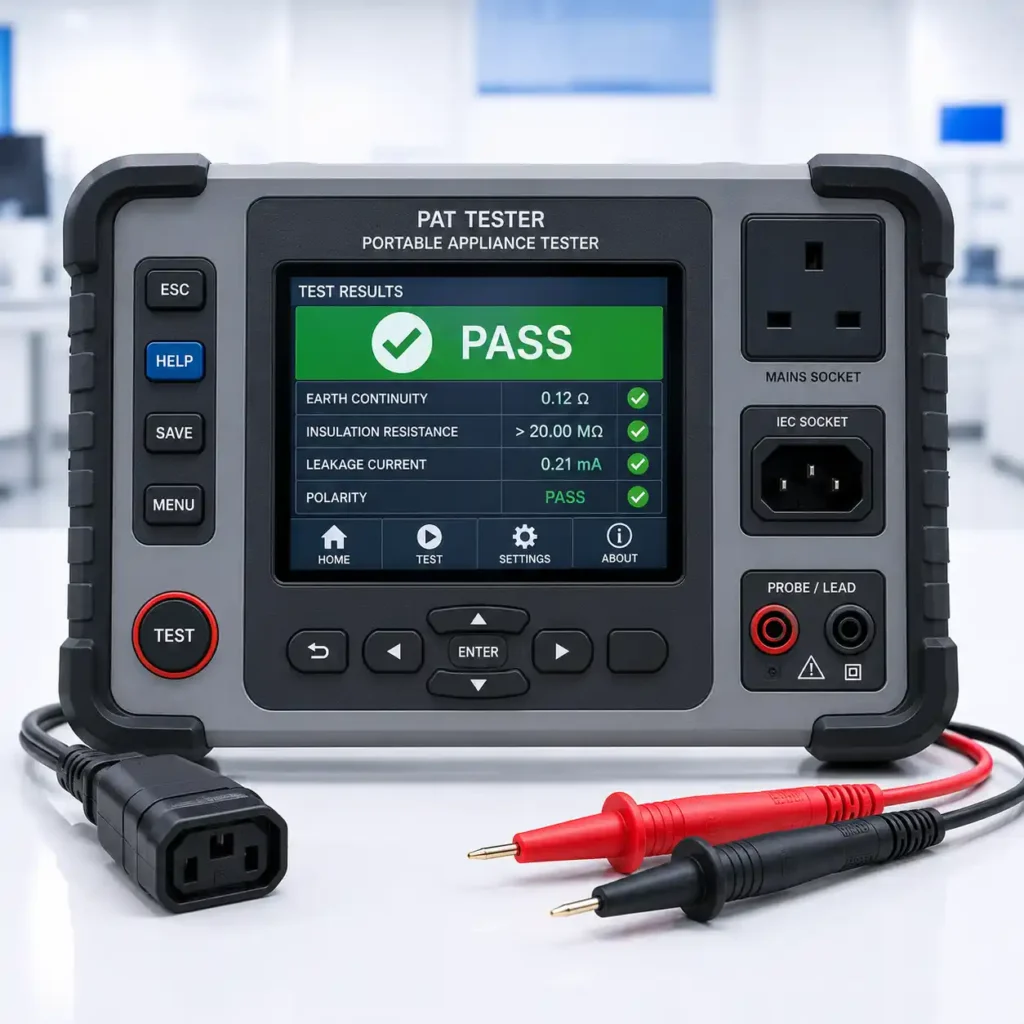
PAT (Portable Appliance Testing)
In-service safety testing of portable electrical appliances
Why it matters: Portable appliances — kettles, drills, extension leads, computers — develop insulation faults, broken earth conductors and damaged cords with use. PAT testing catches these defects before they cause shock or fire.
Test Procedure
- Visual inspection of plug, cord, casing and strain relief for damage.
- Earth continuity test — verify protective earth conductor ≤ 0.1 Ω + lead resistance.
- Insulation resistance test at 500 V DC between live parts and earth (≥ 1 MΩ Class I, ≥ 2 MΩ Class II).
- Polarity check and functional / load test to confirm correct operation.
- Affix pass/fail label with test date, next due date and tester ID; log results in asset register.
Compliance
Audited against the standards that matter.
Every observation in our report is referenced to a clause from a recognised Indian or international electrical safety code.
Ready to audit your electrical system?
Get a comprehensive safety audit conducted by chartered electrical safety engineers — with on-site instrumented testing and a detailed report you can act on.
Schedule a free electrical safety audit today.
One inspection is enough to change everything. Whether you manage a school, hospital, factory, or office — reach out, and we’ll be there.